

As climate change intensifies and urban areas expand, the choices we make for paving surfaces have both immediate and long-term impacts on our environment. An alarming 8% of global carbon dioxide emissions is attributed to cement and concrete production, a figure that has doubled since 1990. With more than 4 billion metric tons of concrete produced in 2022 alone, the repercussions of our paving decisions have never been more significant.
When planning a major renovation or a new build in North America, our focus often stops at the building framework, specifically the roofing, windows, and insulation.
However, the surfaces surrounding a structure are just as critical to its overall efficiency and environmental footprint.
Traditional impervious surfaces like standard poured concrete and asphalt, act as a suffocating lid on the earth, contributing to "heat islands". These create massive stormwater management challenges that can lead to costly property damage.
For builders and homeowners looking to modernize, sustainable pavers offer a high-performance alternative. One, that manages water, reduces carbon, and can even lower long-term infrastructure costs.
The Problem With Traditional Paving
Traditional cement production is a heavy hitter in the climate world. It accounts for roughly 8% of global CO2 emissions.
This is a massive environmental toll for just one building material.
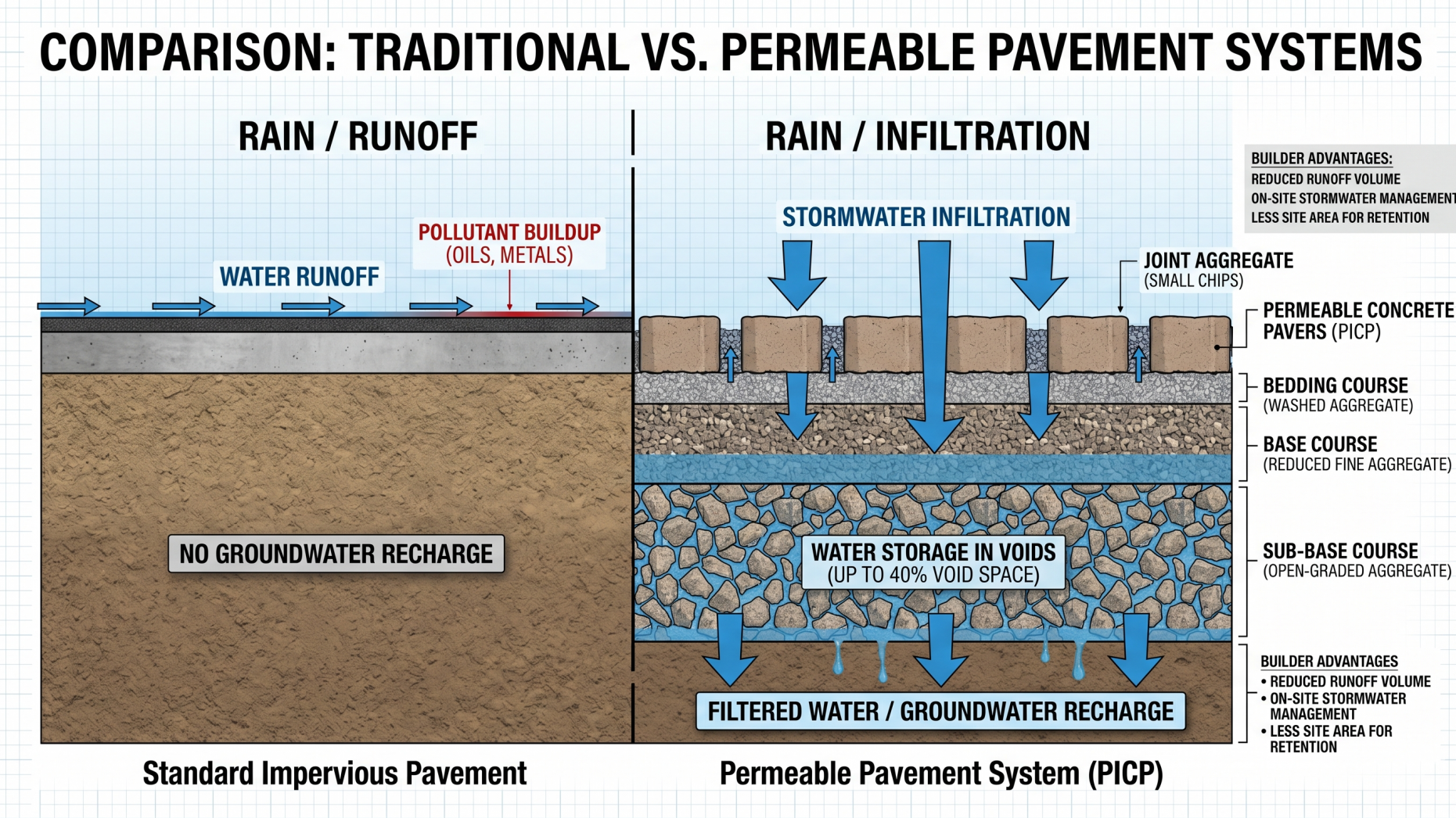
Furthermore, every square foot of standard asphalt acts as a barrier that blocks the ground. It completely prevents the earth from performing its natural duty of filtering water. Rain cannot sink in.
During heavy storms, this trapped water rushes off the property in a destructive wave. It overwhelms local sewer systems and causes non-point source pollution. This happens when toxic oils and chemicals from driveways wash directly into our pristine local waterways. The planet pays the price for our paving choices.
The Benefits of Permeable Pavers
Permeable pavers, or permeable interlocking concrete pavers, are ingeniously designed to manage stormwater effectively. These systems allow rainwater to flow through the paver surfaces and into the layers beneath, reducing flooding and water pollution.
Studies have shown that permeable pavement can decrease surface runoff by up to 85%, thereby filtering out harmful pollutants such as oils and metals before they can reach water systems.
Additionally, these systems provide many environmental advantages:
Reduced Urban Heat Island Effect: Unlike traditional asphalt and concrete, permeable pavers allow for evaporative cooling. This helps reduce the temperature in urban areas.
Enhanced Biodiversity: The infiltration of water supports vegetation growth in the surrounding environment, promoting a balanced ecosystem.
Water Conservation: By facilitating groundwater recharge, permeable pavers help reduce reliance on external water resources while preserving natural aquifers.
Key Features to Look For In Sustainable Pavers
When selecting sustainable paving solutions, homeowners and property managers should consider three main criteria: recycled content, permeability, and durability. The highest eco-friendly options often include materials such as recycled plastic, glass, or rubber.
Permeable pavers can reduce the need for salt/de-icing chemicals in the winter. Because
water drains through rather than pooling and freezing, the surface stays safer with less maintenance.
For a property manager, this means lower slip-and-fall liability and lower chemical costs.
Additionally, carbon-cured concrete pavers present an innovative alternative. Companies like CarbonCure infuse captured CO₂ into their products, not only reducing emissions during the production process but also locking carbon into pavers. Oil, metals, and nutrient runoff can be significantly mitigated through effective permeable designs.
Three Categories Of High-Performance Sustainable Alternatives
To build an efficient property, consider these three categories of paving materials, which utilize facts and figures to prove their worth:
1. Permeable Interlocking Concrete Pavers (PICP)
Unlike standard concrete slabs, these systems use specific shapes that create small gaps.
The Science: These gaps are filled with small, washed stones. This allows water to infiltrate the ground at a rate of up to 100 inches per hour.
The Benefit: This eliminates standing water and reduces the need for expensive drainage pipes and "grey" infrastructure. For a builder, this can mean more usable land, as you may not need as large a retention pond on the property.
2. Recycled and Reclaimed Materials
Sustainability often means using what we already have.
Reclaimed Brick: Old clay bricks have already "paid" their carbon debt. They are incredibly durable, often lasting over 100 years, and offer a high-end aesthetic that increases property value.
Urbanite (Recycled Concrete): Using crushed concrete from local demolition sites saves it from landfills. It is an excellent choice for base layers or decorative "crazy paving" paths.
3. Low-Carbon and Carbon-Cured Concrete
New technology is changing how we make the pavers themselves.
Carbon Sequestration: Some modern manufacturers now use "carbon-curing" technology. This process actually injects CO2 into the concrete as it hardens, trapping the gas forever and making the block stronger.
Fly Ash & Slag: Look for pavers that replace a portion of the Portland cement with industrial byproducts like fly ash. This reduces the "embodied carbon" of the driveway by up to 40%.
Challenges And Considerations
Implementing permeable pavers is not without its challenges, and upfront costs may be higher compared to traditional paving options.
However, the long-term savings from reduced flood mitigation efforts and maintenance should not be overlooked. Regular care is needed to maintain the permeability of these surfaces, necessitating periodic vacuuming or cleaning to prevent clogging.
Any installation must also be consider the local context including soil characteristics, rainfall patterns, and pollutant exposure. Restrictions may apply in areas prone to heavy traffic or pollution from leaks and spills, requiring strategic placement and possibly alternative materials.
Technical Tips For Builders And Renovators
If you are incorporating these into a major renovation, keep these professional standards in mind:
The Sub-Base is Key: A sustainable paver is only as good as the layers beneath it. You generally need 6 to 12 inches of "open-graded" aggregate (crushed stone without the fine dust) to allow for water storage.
Maintenance: While durable, permeable pavers need to be vacuumed or "swept" once a year to remove debris from the gaps. This ensures the infiltration rate stays high for decades. A "clogged" permeable paver often still outperforms traditional concrete in terms of runoff.
-
Local Sourcing: To truly keep the carbon footprint low, source your stone and pavers from within a 500-mile radius of your project. Shipping heavy stone across the country quickly erases the environmental benefits.
North American Climate Comparison: Durability and Cost
Efficiency isn't just about being green; it’s about how the material performs over 20 years in harsh climates.
Feature |
Standard Poured Concrete |
Sustainable Permeable Pavers |
|---|---|---|
Winter Performance |
Traps water; "freeze-thaw" cycles lead to deep cracks and heaving. |
Water drains through; significantly reduces ice buildup and "frost heave" damage. |
Summer Heat |
Absorbs solar energy, raising the temperature of the home's exterior. |
Open-cell and lighter-colored pavers stay cooler, reducing the "Heat Island" effect. |
Stormwater Impact |
Creates 100% runoff; can lead to basement flooding and soil erosion. |
Can reduce runoff by 70% to 90%, protecting the home's foundation. |
Incentives/ROI |
None. |
Many U.S. and Canadian cities offer tax credits or rebates for permeable surfaces. |
While permeable pavers are incredible for managing surface runoff and protecting your immediate driveway area, they also play a massive role in a property's overall structural safety.
How you grade your landscape and capture stormwater directly determines the lifespan of your concrete footings.
To understand how smart ground surfaces work hand-in-hand with below-grade waterproofing to prevent costly structural erosion, read our essential guide on the environmental impact of poor foundation drainage.
Success Stories and Innovations in Permeable Paving
Many municipalities across the U.S. have successfully integrated permeable paver systems into their stormwater management strategies.
Projects in Los Angeles County, have showcased the utility of permeable designs in preventing flooding and improving water quality. The Elmer Avenue Retrofit Project achieved a significant reduction in flooding and increased groundwater recharge.
Innovations such as hybrid pavement systems and photocatalytic pervious pavements are emerging on the landscape, pushing the boundaries of what's possible in urban development while supporting sustainability goals.
The Future of Sustainable Paving
For boutique hospitality professionals looking to operate sustainably, investing in permeable pavers and other eco-friendly materials is both a responsible choice and a market differentiator.
By reducing environmental impact and enhancing the guest experience, you’re not just paving paths...you’re laying the groundwork for a sustainable future.
As you embark on your next renovation or build, consult with a local civil engineer or landscape architect to see how permeable surfaces can maximize your buildable lot area by reducing stormwater retention requirements.




Write A Comment